
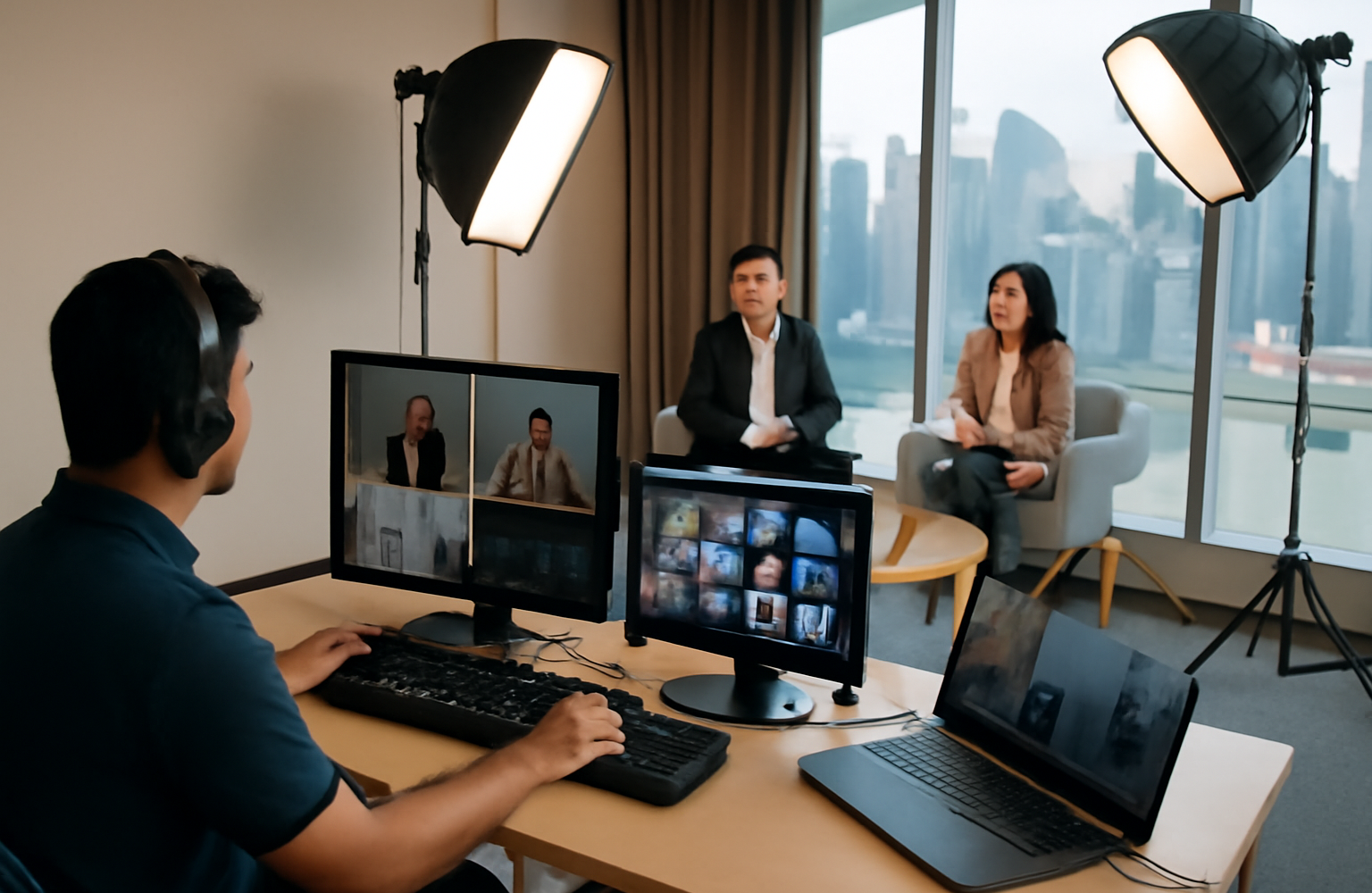
Virtual events are no longer a stopgap — for many Singapore companies they are now a permanent part of the calendar, whether that is a fully online town hall, a webinar for regional clients, or a hybrid launch that streams a live audience to viewers around the world. Done well, a virtual or hybrid event reaches people who could never attend in person and can be more cost-effective than flying everyone in. Done poorly, it is a laggy stream and a bored audience. This guide covers the practical decisions — platform, AV, staging and engagement — that separate the two.
Virtual, hybrid and in-person: what’s the difference?
It helps to be precise about the format before you plan anything else:
- Virtual events are entirely online — every speaker and attendee joins remotely. Think a webinar, an online AGM or a distributed team town hall.
- Hybrid events combine a physical audience with a remote one. Speakers present in a room to live guests while cameras stream the session to viewers elsewhere.
- In-person events are the traditional format, sometimes recorded for later sharing.
Hybrid is the most demanding to produce because you are effectively running two events at once and have to keep both audiences engaged. That is where professional AV and staging earn their keep — a remote viewer will forgive a lot, but not poor sound or a camera pointed at the back of someone’s head.
Choosing the right platform
The platform is your virtual venue, so match it to the event type. For internal town halls and smaller meetings, familiar tools such as Zoom or Microsoft Teams are usually enough — everyone already knows how to use them. For larger webinars with registration, polls and Q&A, a dedicated webinar platform gives you more control and better analytics. For big flagship events with multiple sessions, sponsor booths and networking, a purpose-built virtual-event platform is worth the extra cost.
Whatever you choose, test it early with the actual devices and network your speakers will use. The most common failure at a Singapore virtual event is not the platform itself but a presenter’s home Wi-Fi or an untested screen-share. Build a technical rehearsal into your timeline and it will pay for itself.
AV and staging: the difference-maker for hybrid events
For anything beyond a simple webinar, the production quality is what makes a virtual event feel professional. That means proper cameras rather than a laptop webcam, dedicated microphones so remote viewers hear clearly, controlled lighting, and a vision mixer to switch cleanly between speakers, slides and video. A large backdrop or LED screen and staging setup lets you display branding, slides and live video to the room while the same feed goes out to the stream, keeping both audiences in sync.
Good audio matters even more than good video. Invest in a proper sound and lighting package so speakers are heard clearly and the room looks the part on camera. A dedicated technician to run the stream and handle the inevitable hiccups — a dropped speaker, a slide that will not advance — is the single best insurance you can buy for a live event.
Keeping a remote audience engaged
The hardest part of any virtual event is holding attention when your audience is one click away from their inbox. A few tactics that genuinely work:
- Keep sessions short. Online attention spans are shorter; break long content into segments with breaks.
- Use live polls and Q&A so viewers participate rather than passively watch.
- Assign a host or emcee to keep energy up and bridge between speakers.
- Add interactive moments — a virtual quiz, a live shout-out, or a giveaway for those who stay to the end.
- Send physical touches — for high-value events, mailing attendees a small kit or refreshment beforehand makes the experience feel real.
For hybrid events, do not neglect the remote audience in favour of the room. Have someone monitor the chat and feed remote questions to the speakers so online viewers feel part of the event rather than spectators.
What virtual and hybrid events cost in Singapore
Costs vary enormously with ambition. A simple internal webinar run on an existing platform might cost little beyond staff time. A polished hybrid event with multiple cameras, professional lighting, LED staging, a technical crew and a bespoke platform can run into five figures. The main cost drivers are the number of cameras and crew, the venue and its AV infrastructure, the platform licence, and the level of branding and staging.
Rather than a fixed price, think in tiers: a basic streamed session, a mid-tier multi-camera production, and a full flagship hybrid event. Decide which tier your objectives justify, then request a quote built around that. Because hybrid events combine venue, AV and production, bundling them with one corporate events partner is usually more cost-effective and far less stressful than coordinating separate vendors.
Planning timeline and logistics
Give yourself time. A realistic sequence for a mid-sized hybrid event:
- 6–8 weeks out: confirm format, platform, date and a venue with reliable connectivity.
- 4 weeks out: lock speakers, run order and AV requirements; open registration.
- 2 weeks out: brief speakers, prepare slides and holding graphics, plan engagement moments.
- 1 week out: full technical rehearsal on the real setup, including a network stress test.
- Event day: arrive early, test everything again, and have a technician on standby throughout.
If you are hosting a hybrid audience in person, choose your function room or event space partly on its internet reliability and power — a beautiful venue with weak bandwidth will undermine the stream.
Frequently asked questions
What is the difference between a virtual event and a hybrid event?
A virtual event is entirely online, with all speakers and attendees joining remotely. A hybrid event has a live in-person audience while simultaneously streaming to remote viewers, so you are effectively producing for two audiences at once.
How much do virtual events cost in Singapore?
Costs range widely. A simple internal webinar can cost very little beyond staff time, while a full hybrid production with multiple cameras, LED staging and a crew can reach five figures. The main drivers are crew, cameras, venue AV and platform. Request a quote for your scope.
Which platform is best for a virtual event?
It depends on the event. Zoom or Teams suit internal town halls, dedicated webinar tools suit larger sessions with registration and analytics, and purpose-built event platforms suit flagship events with multiple tracks and networking. Test whichever you choose before the day.
How do I keep remote attendees engaged?
Keep sessions short, use live polls and Q&A, assign a host to maintain energy, and add interactive moments such as quizzes or giveaways. For hybrid events, actively monitor the chat so remote viewers’ questions reach the speakers.
Produce a virtual event that actually lands
Virtual and hybrid events reward preparation — the right platform, solid AV, and a plan to keep every audience engaged. As a Singapore event studio, we bring the LED staging, sound and production crew together under one roof so your online and in-room audiences get the same polished experience. Get in touch for a quote or WhatsApp us, and we will help you plan a virtual event worth showing up for.